

On steel structural drawings, we often write "Q235" for general structural components. But when purchasing or talking with an experienced foreman, they will always ask: "Do you want A, B, C, or D?" This is not just a difference in procurement cost. The essential difference lies in the control of internal "impurities."
What does "Q235" mean?
First, let us quickly decode the name:
Q: Stands for "Qū" - the pinyin initial for "yield" in Chinese. In English, it means yield strength.
235: Means the minimum yield strength of this steel is not less than 235 MPa.
This means that whether it is Grade A, B, C, or D, the basic mechanical property threshold is the same - the yield strength is 235 MPa. So from the standpoint of static strength calculation, if Grade A passes, Grade D will also pass.
Then why are there different grades?
The core issue is that steel is not merely an alloy of iron and carbon. During smelting, it inevitably brings in some "unwelcome guests" - mainly sulfur and phosphorus.
The destructive effects of sulfur and phosphorus
Sulfur: Sulfur combines with iron in steel to form iron sulfide (FeS). This is a low-melting-point brittle compound that is distributed in isolated form along grain boundaries. When the steel undergoes hot working - such as welding or forging - these iron sulfide films can melt, causing a sharp drop in grain-boundary cohesion. This produces hot shortness and makes welding hot cracks very likely in the weld heat-affected zone.
Phosphorus: Phosphorus has a strong solid-solution strengthening effect in steel, but this is a double-edged sword. It sharply raises the ductile-to-brittle transition temperature. This means that at low temperature or under impact load, steel with high phosphorus becomes more brittle, its toughness drops sharply, and low-temperature brittle fracture is likely. This phenomenon is called cold brittleness.
Simply put: sulfur fears heat; phosphorus fears cold.
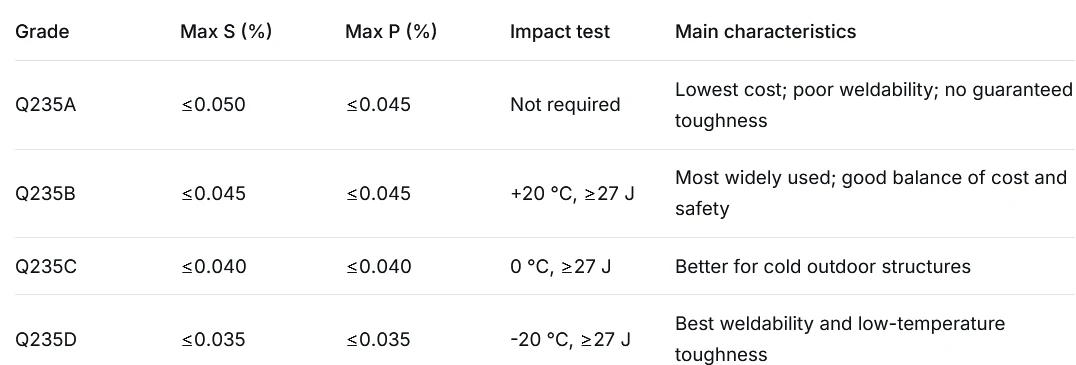
Q235A - "Economical/Basic Grade"
Characteristics: Loosest control of sulfur and phosphorus; no guaranteed impact toughness.
Risk: Poor weldability; no guaranteed toughness at low temperature; high brittleness.
Applications: Only for static, room-temperature, non-welded secondary structures, such as non-load-bearing guards and machine feet. In important mechanical structures, Grade A should be avoided as much as possible.
Q235B - "Mainstream Workhorse"
Characteristics: Sulfur content is slightly reduced, and a mandatory +20 °C room-temperature impact test is required, ensuring a certain toughness reserve.
Applications: This is the most widely used grade. It is used for most room-temperature, static or general dynamic welded structural components, such as frames, housings, platforms, and railings. It is the best balance between cost-effectiveness and safety.
Q235C - "Low-Temperature Entry Grade"
Characteristics: Stricter control of sulfur and phosphorus, and a 0 °C impact test is required.
Applications: Suitable for outdoor structures in cold winter regions, such as North and Central China, or welded components subjected to some impact load. Examples include outdoor conveyor frames and construction machinery structures in non-extreme cold regions.
Q235D - "Low-Temperature High-Toughness Grade"
Characteristics: Strictest control of sulfur and phosphorus, and a -20 °C impact test is required.
Applications: Used for important welded structures and low-temperature service environments, such as severe cold regions and freezer or cold-storage workshops. Examples include main structures of large bridges, crane main girders under dynamic load, and pressure vessel components. It has the best weldability and low-temperature toughness.
Practical selection guide
Scenario 1: Welding
Wrong choice: Using a Q235A plate to weld a critical frame.
Result: During welding or later under service vibration, microcracks easily form in the weld heat-affected zone, becoming initiation sites for fatigue fracture.
Correct choice: For any welded structure, the minimum grade must be Q235B. For critical welds or structures requiring mandatory non-destructive testing, Grade C or even Grade D should be preferred, because lower sulfur content significantly reduces the risk of welding hot cracks.
Scenario 2: Low temperature and environment
Wrong choice: In Northeast China, outdoor equipment supports used Q235A or Q235B.
Result: On a night when the temperature was in the teens below zero Celsius, a normal load could trigger brittle fracture, with a fracture surface as flat as if cut by a knife.
Correct choice: Select material based on the minimum operating temperature of the equipment compared with the impact test temperature. In principle, the service temperature should not be lower than the material's impact test temperature.
Scenario 3: Dynamic load and impact
Wrong choice: A machine base subjected to repeated start-stop impact used Q235A to save money.
Correct choice: Wherever impact or vibration exists, at least Q235C or a higher grade should be selected, because phosphorus is controlled more strictly, cold brittleness is lower, and toughness is better.
Summary
Choosing Q235 A/B/C/D is a trade-off among cost, processability, and environmental safety.
Do not cut costs where you should not: The small price difference between Grade A and Grade B buys a qualitative leap in welding safety and basic toughness. That investment is always worth it.
Remember the core logic: From A to D, impurity content - sulfur and phosphorus - becomes lower, the steel becomes cleaner, and toughness, especially low-temperature toughness, becomes better.
So next time you specify material on a drawing, carefully choose that suffix letter according to the importance of the structure, welding requirements, and service environment. It is not just a letter; it is a reflection of your responsibility as a designer.